- Determine modulation parameters like FSK modulation type, symbol-rate, shift, etc.
- Welch zoom spectrum
- Weighted frequency histogram
- Weighted frequency trace display
- F3 spectrum symbol rate measurement
- Differential phase I/Q display (MSK)
- Spectrum of the 4th power (MSK)
- Eye diagram of the instantaneous frequency (MSK)
go2signal-analyzer
go2signal‑analyzer provides both manual and automated offline modulation analysis with a user‑friendly workflow. It gives analysts and operators fast access to all relevant modulation parameters through a set of predefined views—without requiring step‑by‑step configuration or manual setup of mathematical operators.
The analysis results can be used to identify and document signals or to design new demodulators and decoders in go2modem‑studio for use in go2monitor.
Key Facts
- Predefined analysis windows for fast, reliable results
- Offline analysis with support for multiple file formats
- Combines expert‑level analysis logic with your own operational knowledge
- Easy to use—suitable for both beginners and experienced analysts
- Simple signal selection by frequency and time range
- Dedicated analysis screens for: Time, Periodicity, Classification, PSK, OQPSK, QAM, FSK, MFSK, MC‑PSK, OFDM
- Integrated demodulator for bitstream extraction
- Visualization tools: Waterfall, Spectrum, Histogram, Auto‑correlation, Constellation, Scatter, and more
- Runs on standard COTS computer hardware
Modulation Analysis
FSK / MSK
PSK
- Determine modulation parameters like PSK modulation type, symbol-rate, version, etc.
- Multiple squared signal spectra display with automatic frequency correction
- N’th power spectrum of phase center offset frequency measurement
- A3 Spectrum symbol rate measurement
- Absolut I/Q display with PLL and differential I/Q display
- Differential phase histogram
OQPSK
OQPSK is a special case of QPSK (also known as PSK‑4A) in which the Q‑branch is delayed by half a symbol relative to the I‑branch before transmission. This offset reduces the amplitude variations in the waveform compared to standard QPSK.
- Determine modulation parameters like OQPSK modulation type, symbol-rate, etc.
- Two squared signal spectra display with automatic frequency correction
- 4’th power spectrum of phase center offset frequency measurement
- A3 Spectrum symbol rate measurement
- Absolut I/Q display with PLL and differential I/Q display
- Absolut I/Q display with PLL of even and odd symbols
- Differential phase histogram
MC-PSK/QAM
- Determine modulation parameters like multicarrier PSK and QAM modulation type, symbol-rate, channel count, channel distance, etc.
- Autocorrelation channel/carrier count and distance measurement
- Average spectrum with channel position markers, numbers and selection
- A3 Spectrum symbol rate measurement of selected channel/carrier
- Differential I/Q display of selected channel/carrier
Automatic parameter estimation is based on statistical parameters of the signal. The analysis performs best on a strong (high SNR), undistorted signal. Idle or repeating symbol sequences may lead to confusing analysis results.
QAM
This module is optimized for the detailed analysis of QAM modulated signals.
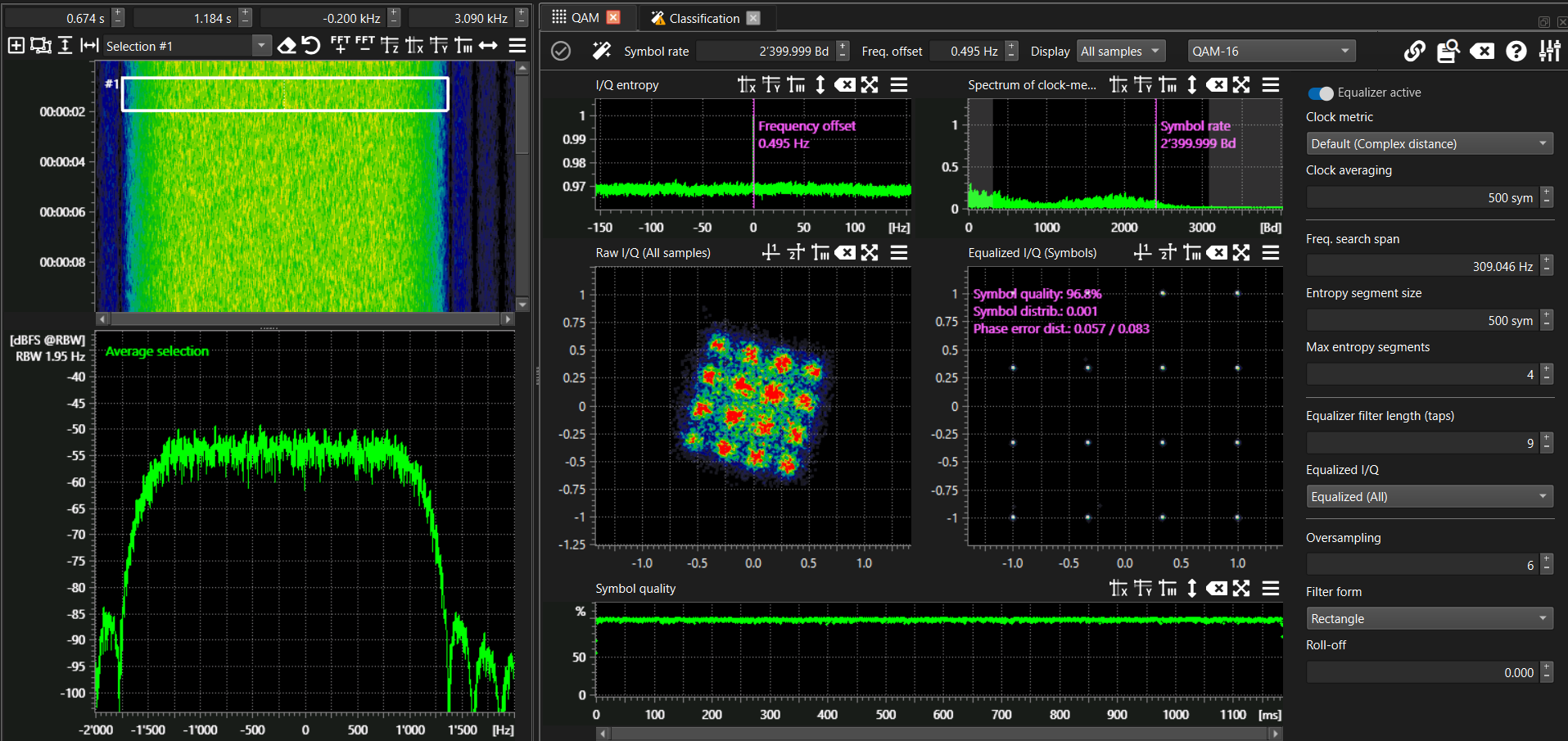
- Determine modulation parameters like PSK and QAM modulation type, symbol-rate, etc.
- High performance blind equalizer supporting many different PSK and QAM modulation types from PSK2,4,8,16,32 up to QAM4,8,16,32,64,128
- Spectrum symbol rate measurement with selectable clock metric
- Raw and equalized I/Q display
- Equalizer error based symbol quality analysis
MFSK
Various metrics are calculated and displayed as plots, enabling the user to determine the parameters of the modulation.
- Determine modulation parameters like MFSK modulation type, tone count, tone duration, tone distance, etc.
- Spectrogram with automatic tone marking
- Histogram over tone frequencies for tone distance measurement
- Tone number histogram
- F3 spectrum symbol rate measurement
In contrast to the FSK analysis, more than 4 tones can be determined and measured.
OFDM (Option)
This module is optimized for detailed analysis of OFDM modulated signals.
OFDM signals are a special case of multi-carrier modulated PSK/QAM signals.
The analysis performs an automatic estimation of the basic modulation parameters. These parameters can be checked by the user and modified if necessary.
The following parameters can be measured using the analysis results:
- Carrier scatter plots for differential phase, absolute phase and magnitude
- Time behavior scatter plots for differential phase, absolute phase and magnitude
- Multicarrier absolute and differential I/Q display
- Decision directed PLL absolute and differential demodulation for PSK2, PSK4, PSK8, PSK16, QAM4 and QAM16 modulation
- Multicarrier absolute and differential soft decisions symbols I/Q display
- Bit display for demodulation result
- Special multicarrier PSK/QAM mode with phase and pulse form correction
- Analysis result export to go2monitor and go2modem-studio as modem description or demodulator parameter file
The following assumptions and restrictions apply:
- The analyzed signal is an OFDM or a multi-carrier PSK/QAM signal
- Optimal results can be expected only for OFDM signals employing a cyclic prefix (CP-OFDM)
- There is enough signal available for processing, at least a few hundred symbols are recommended:
- The analysis performs best on strong (high SNR) and undistorted signals.
- Repeating symbol sequences (e.g. idle sequences and pilots) may lead to confusing analysis results.
Additional Functions
Preprocessing
The entries in the “Preprocessing” menu are used to process an input signal before the actual analysis. Some modulation methods require analog pre-processing before go2studio-analyze modules can be used successfully.
- AM is used to remove analog AM modulations
- FM is used to remove analog FM modulations
- Crop is used to reduce the file size so that go2studio-analyze can work faster
- DeChirp is used to remove a linear chirp up or down modulation
Audio
The following demodulators are available:
| DIG | CW | AM |
| USB | LSB | FM |
Classification
- Automatic modulation classification of a signal contained within selection
- Includes modem classification
- See "Technical Data" for supported modulation and modem types
Signal Information Database
- Includes parameters such as name, modulation, symbol rate, channels, channel spacing, shift, auto-correlation, band, alias, and more
- Automatically generated filters from analysis results help identify matching modems
- User‑editable and fully user‑expandable
- Export to Excel for external processing
Time Analysis
The Time Analysis module provides various time domain diagrams for manual analysis of basic emission characteristics, e.g. the modulation type of an emission.
The Time Analysis shows three diagrams that can contain:
- Amplitude
- Phase
- Frequency
- Amplitude (I+Q)
- Real (in phase)
- Imaginary (quadrature)
- Power (squared magnitude, lin.)
- Level (log. power)
- Initial configured for time behavior of instantaneous magnitude, phase and frequency comparison (AM, PM and FM demodulation)
- Additional instantaneous signals (amplitude, in-phase, quadrature, power and level) selectable
- Each plot with additional histogram
Periodicity Analysis
The analysis is performed depending on the selected metric and an auto-correlation is displayed to immediately detect dominant periods of repeating components.
Repeating sequences become visible in a circular display.
- Several analysis modes like instantaneous frequency, weighted frequency, differential phase and magnitude
- Autocorrelation display to measure repetition circulation time
- Circulation (Hell) display synchronized with auto-correlation measurement
Universal Demodulator
This module provides demodulation functions for various modulation types. The purpose of the module is to visualize the demodulation quality to enable the user to optimize the demodulation parameters
- See table of demodulators in the "Technical Data" . M specific demodulators are not available for analysis.
- Demodulation of bursted signals
- Demodulation of multi channel signals
- Parametrizable in modulation type, symbol rate, shift, channels, channel distance, symbol table, burst parameters, etc.
- Bit display with parametrizable columns per row, burst sync., quality and different styles
- Symbol and modem export